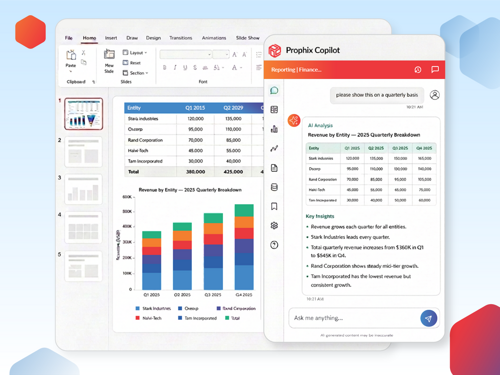
AI is helping to reshape financial modeling, forecasting, and closing to become more efficient, effective, and easier to control. It’s a shift that is transforming the role of finance and accounting from manual, periodic analysis to more continuous, controllable, data-driven decision making. Autonomous AI operates as a capacity multiplier, while finance retains complete control and oversight behind the scenes.
What Is AI in Financial Modeling?
AI in financial modeling refers to intelligent systems that automate and enhance forecasting and analysis, giving human experts more capacity to handle higher-level judgment and more strategic work. It is continuously adaptive, supporting modeling, risk assessments, and portfolio optimizations, and moving finance and accounting teams away from restrictive manual processes.
Core Applications and Use Cases
When used in financial modeling, AI supports more accurate planning and higher throughput across various cycles - with measurable workflow outcomes. It can be deployed to manage workflows end-to-end and augment existing processes to boost productivity and confidence.
Core applications and use cases include:
- Financial forecasting: AI that trains on historical data from fragmented ERPs and other systems removes the need for manual, spreadsheet-based forecasting. By ingesting this data, it predicts seasonal changes, gives insights into buyer behavior patterns, and adapts on-demand forecasts in line with changing markets. The net output is more reliable, adaptable forecasting that supports more confident decision-making.
- Scenario modeling: Developing manual “what-if” scenarios requires extensive time, coordination, and manual effort. AI can develop and run multiple financial scenarios in real-time and simulate market and competitor assumptions to quickly analyze how risks play out.
- Risk assessment: Finance teams use AI to spot red flags and anomalies in statements or financial patterns, and analyze documents to raise exceptions. Doing so means teams can process more compliance and risk checks faster, more accurately, with AI always learning and adapting.
- Portfolio optimization: AI synthesizes market data and historical patterns to support finance teams running capital allocation analysis across business units, projects, and product lines. By surfacing scenario ranges and trade-offs, AI gives finance leaders better-informed inputs for capital planning decisions. The decisions themselves stay with the team.
- Valuation modeling: AI assists DCF analysis, comparable-company valuation, and transaction multiples by automating data collection and updating market inputs as conditions shift. Finance teams retain ownership of the methodology and assumptions; AI compresses the time spent on data assembly.
- M&A due diligence: AI accelerates due diligence by analyzing financial statements, market reports, and operational data faster than manual review allows. M&A teams can identify synergies, risks, and integration considerations earlier in the process.
- Fraud detection: Machine learning models trained on historical transaction patterns identify anomalies and suspicious activity at scale — duplicate invoices, unusual vendors, off-pattern approvals. AI surfaces signal; finance decides what action to take.
- Revenue and expense tracking: AI automates tracking and reconciliation across multiple revenue streams and cost structures, surfacing inefficiencies and giving finance current insight into financial health on demand.
Traditional vs. AI-Driven Financial Modeling
AI in financial forecasting is not a replacement for traditional, manual techniques and processes, but an evolution. Traditional modeling, while effective, requires extensive human time and effort, and is prone to extending cycles, straining capacity, and increasing error risk under deadline pressure – especially as needs evolve and businesses grow.
By using AI in modeling, finance teams gain speed, precision, and scalability compared to traditional processes.
It can process and model data in real time, vs. larger manual requests taking weeks to complete. From an accuracy perspective, AI can identify hidden patterns and anomalies. And, by processing high volumes of data at speed, it is a scalable, growth-proof solution.
In addition, AI-driven financial modeling adapts continuously, meaning it improves its outputs as new data lands and applies that knowledge to future workflows. With glass-box AI, too, finance teams benefit from a fully-explainable system that can be adjusted or recalibrated at any time, allowing for easy governance and a robust audit trail.
Key Benefits of AI in Financial Modeling
There are several immediate benefits to moving to AI financial modeling from traditional, manual processes:
- Higher accuracy and fewer errors: AI-driven models pull data directly from systems and run calculations consistently, reducing manual rework and the risk of human error. Forecasts are more reliable, variance checks decrease, and finance spends less time correcting mistakes downstream.
- Faster planning cycles: What used to take weeks of manual data assembly now runs in days or hours. Forecasts move from periodic snapshots to continuous streams, with rolling updates as new data lands. End-to-end cycle time compresses, and quarter-end becomes a review event rather than a build event.
- Real-time insights for decision-making: Finance leaders work from current, validated numbers in every important conversation. There is less time spent manually verifying figures before decisions are made, and planning discussions are grounded in data that is hours old, not weeks.
- Stronger risk detection: AI identifies anomalies, outliers, and patterns that manual review could miss. Risk signals surface earlier in the cycle, giving finance the time to investigate and respond before issues compound.
- Scalability without added headcount: AI supports modeling across multiple data sources, currencies, and entities, expanding capacity as the business grows. New units, systems, and reporting requirements can be absorbed without proportional increases in workload.
Choosing AI software for financial modeling comes down to four practical considerations: integration depth, the strength of the AI capabilities themselves, the user experience for finance teams, and the security posture for sensitive financial data.
The market for AI-powered financial modeling tools includes general FP&A platforms, specialized modeling software, and embedded AI inside ERP and finance systems. The right choice depends on the size of the team, the complexity of the modeling work, and the integration with existing systems.
Below are the capabilities to evaluate when comparing AI financial modeling software.
Integration With Existing Systems
Look for software that connects to your ERP, billing platform, CRM, and data warehouse. Pre-built connectors to common platforms (SAP, NetSuite, Microsoft Dynamics, Oracle, QuickBooks) reduce implementation time. APIs and flexible source-system support handle the cases where pre-built connectors don't exist. Smooth data flow is the precondition for AI-driven modeling — without it, the AI is working from incomplete or stale inputs.
AI Capabilities and Methods
Strong AI financial modeling tools combine several capabilities: machine learning algorithms for pattern detection and predictive forecasting, ensemble modeling for scenario robustness, anomaly detection for risk identification, and natural language processing for narrative drafting and chat-based model queries. Look for platforms that document how their AI works (glass-box, traceable logic) rather than treating it as a black box.
User Experience and Accessibility
Finance professionals should not need to write code to use AI in financial modeling. The interface should support familiar workflows, integrate with Excel where appropriate, and offer model-building tools designed for finance users rather than data scientists. Predictive insights, visualization tools, and what-if scenario modeling should be one or two clicks away — not buried under technical configuration.
Security and Compliance
Financial data is sensitive. AI software handling it needs strong encryption (at rest and in transit), role-based access controls, comprehensive audit logging, and compliance with relevant standards (SOC 2, GDPR, SOX requirements where applicable). For finance teams operating in regulated environments, glass-box explainability is a security requirement, not a feature — black-box AI inside a financial model creates compliance risk.
Glass-Box Explainability
Every AI-driven decision inside a financial model should be traceable. Finance teams need to be able to point at any output — a forecast, a scenario, a flagged anomaly — and explain how the AI reached that conclusion. Without explainability, the model can't be defended to auditors, the board, or anyone else asking why a number is what it is.
Where Implementation Requires Attention
Financial modeling implementation requires high-quality, centralized data, and a smooth, staggered rollout across existing systems and processes.
Here are some key practical steps to consider:
- Lead with process and workflow design before implementing modeling AI across the board. To start, ensure that data inputs are structured and clean, so that AI can drive stronger, more insightful outputs (and therefore deliver more value).
- Choose glass-box AI over black-box models. As mentioned, glass-box solutions keep every decision explainable and easy to trace - black-box delivers outputs without revealing the logic behind them.
- Add review and governance layers to your process design so that AI can be recalibrated as conditions change. Build checkpoints during rollout so reviewers can validate outputs against expected results, and address any data or model design gaps that surface in early cycles.
- Reviewing and recalibrating is crucial for long-term value with AI. It learns and improves its performance over time, and regular checkpoints ensure it continues to evolve in line with shifts in forecasting demands.
- Ultimately, finance must retain oversight, judgment, and the ability to review exceptions. It’s through this model that AI augments existing processes - it handles volume, while human experts handle judgment and analysis.
Implementing AI in Financial Modeling: Best Practices
Implementing AI in financial modeling effectively means taking time to work on process and workflow design first, and to carefully consider how it will integrate with existing ERPs and data flows. From there, focus on building team capability and empowering their skills while phasing out deployment.
Integration with Existing Systems
Fragmented sources compound toward extensive manual investigations, rework, and forecasting slowdowns. Process and workflow design are just as important as AI and automation, and that means ensuring current data flows and ERP connectivity are clearly mapped out before deployment.
Once a map has been developed, compare AI solutions that integrate cleanly with your chosen ERPs, prioritizing the development of a single source of truth working from separate sources.
In addition, data formats should always be standardized before implementation. Doing so ensures that recalibration and reviews are more straightforward and that there is less risk of manual rework post-AI.
Building Team Capability
Positioning AI as “just another tool” risks resistance, meaning it is important to empower finance and accounting teams on its compounding value. Focus on the long-term benefits of introducing AI into modeling and developing people’s capabilities around tools as implementation continues.
Effective AI in financial modeling depends on a specific set of finance skills: data literacy (working with structured and unstructured datasets), an understanding of model governance and how to challenge AI outputs, familiarity with machine learning concepts at a working level, scenario planning and what-if analysis design, and the ability to collaborate with data science or technical teams when models need calibration. None of these require finance professionals to become data scientists. They do require investment in capability building from day one.
Be clear that finance still owns workflows and decisions, and that capabilities will expand alongside AI’s coverage and insight. Offer clear guidance in new workflows where AI starts and ends, and how team members can control and adjust outcomes if necessary.
Establish and always be aware of the fact that capability building is an ongoing process. AI’s true value will only compound so much as teams become more fluent in how to work with it.
Implementation Process
A phased implementation ensures that any existing workflows and systems embedded in your process are protected against change. Phasing deployment helps to control risks and potential errors, ensures that resources are adequately managed, and that data is fully prepared for rollout.
At the start of implementation, focus on the use cases with the highest impact ratio. For example, forecasting is a use case you can focus on with AI modeling, with a future rollout impacting reconciliation and close management.
Ensure that you have staggered review and validation layers and checkpoints established - these set a bottom line for governance long after deployment, not just to act as a safeguard during experimentation.
Security, Compliance, and Trust
Given that AI in finance handles high-volume, highly sensitive information and makes decisions based on historical data, it is vital to establish a system of trust, transparency, and security. Doing so supports ongoing compliance, addresses potential resistance, and supports stakeholder relationships.
Regulatory alignments and compliance expectations dictate that there should always be data security standards and clear audit trails to explain how information is processed and handled, and what steps are taken to ensure its integrity.
Audit readiness for alignment with standards such as SOX and its equivalents means not only having clear data controls in place, but also ensuring that AI’s access to this data, and how it makes decisions, are fully documented.
Glass-box AI ensures this with model logic and decisions being completely explainable, traceable, and owned by finance. This last element is a cornerstone of ethical AI-driven financial reporting, as it means controls are designed within the process, not added as an afterthought.
In addition, stakeholders, like auditors, expect full transparency with regard to data security and processing. That includes establishing clear audit trails, ensuring that data is only available through role-based access, and that AI decision logic is fully documented.
Practical Examples and Case Studies
Let’s explore some practical ways finance leaders can apply AI in financial modeling to their own operations.
Forecasting cycle compression
Automating data aggregation and analysis enables finance teams to drastically shorten forecasting cycles by creating a more accurate “rolling” system that continuously updates projections as new data arises. There is no need for extensive manual investigations or fact-checking.
Encore Electric, for example, uses Prophix One to automate its budgeting cycles, having previously spent almost 2,000 hours manually consolidating data (per cycle). Since adopting the software, the company has saved 1,800 hours per budget cycle, removed bottlenecks, and reduced its time-to-budget by 30 minutes.
Close acceleration
AI helps finance teams move away from reactive manual tasks toward proactive processes, by handling high-volume tasks such as intercompany eliminations and journal entry aggregation as data arises.
By the time close deadlines start to approach, teams already have a wealth of accurate, complete datasets to report on - reducing time spent manually checking and reworking spreadsheets.
Using Prophix One, Jamul Casino now has greater control over month-end closes than ever before, having reduced its budgeting cycle time by 58%, and saving $15,000 in labor efficiency costs purely based on monthly closes.
Scenario modeling speed
Using historical and real-time data analysis and through gradual learning, AI can create potential risk scenarios in minutes, not days or weeks. This allows finance leaders to gain greater confidence in potential decisions and to take action faster, potentially claiming a competitive edge.
Wilson Construction Company, which develops critical electric utility infrastructure, relies on accurate, timely project data to deliver insights into work in progress.
With Prophix One, the company produces automated monthly finance statements, and also uses work-in-progress (WIP) reports so everyone is clear on how projects are progressing in real time. The compounding result is a saving of four days in every month on weekly reports, and up to two weeks in every month for GL and WIP reports.
Future Trends in AI and Financial Modeling
AI in financial modeling is shifting away from basic automation and efficiency boosts towards continuous workflows with embedded controls. This shift will continue to enable finance teams to work more as strategic advisors, vs. data handlers and processors.
Real-time analytics integration is already helping finance teams gain insight into current positions via individual dashboards, presenting critical data in single, centralized locations. This is immensely helpful both in ongoing planning and ensuring data is visible for a faster, more controlled close.
A wider cross-entity deployment of AI is also a current trend, thanks to businesses adopting solutions that break down silos and communication barriers. High-level workflows allow different departments and functions to see the benefits of AI modeling and high-volume task management.
Agentic AI capabilities, too, already allow finance teams access to detailed insights purely by asking specific questions. Emerging, safeguarded capabilities can pull up real-time data and give answers during meetings, for example, greatly cutting down waiting time for forecasts.
All considered, the rapid growth of AI means that there is greater scrutiny of its functions and effects than ever before. Evolution in regulatory expectations will shape the individual AI governance requirements of each company that uses it, whether for ongoing scenario modeling or continuous closing.
A durable, sustainable approach to meet this shift is to ensure that compliance and ownership controls are embedded in workflow design. As Charles James’ research states, it’s important to address interpretability challenges and consider the ethical implications of AI to truly anticipate its full potential. (James, C.)
Ultimately, finance is expanding with AI, not contracting. Finance and accounting teams will continue to provide essential judgments, strategy building, and guardrail oversight as AI takes over manual tasks. This trio forms finance professionals’ core competencies. Finance teams will continue to review exceptions, while AI handles the broader processing.
FAQs About AI in Financial Modeling
What's the difference between AI in financial modeling and traditional Excel modeling?
Traditional modeling sits in spreadsheets, with assumptions hard-coded by the analyst and data refreshed manually. AI in financial modeling automates the data layer (live source-system connections), refreshes drivers based on new inputs, and runs scenarios at scale. The methodology and assumptions still belong to finance, but the build-and-refresh cycle compresses dramatically.
How accurate is AI-driven financial modeling?
Accuracy depends on data quality, the model design, and the consistency of inputs. With clean, structured data and a glass-box implementation, AI-driven forecasts typically outperform static spreadsheet forecasts on both accuracy and refresh cadence. The bigger gain is the rolling cadence: AI updates continuously instead of monthly or quarterly.
Is AI safe to use inside a SOX-controlled financial model?
Yes, when proper controls are in place. SOX compliance requires explainable decisions, complete audit trails, controlled access, and documented human review at every checkpoint. Glass-box AI — with traceable, reviewable, and adjustable outputs — supports each of these requirements. Black-box AI inside a SOX-controlled model creates compliance risk and should be avoided.
Can AI tools integrate with existing ERP and financial systems?
Yes, when the AI software is built for finance integration. Look for platforms with established connectors to major ERPs (SAP, NetSuite, Microsoft Dynamics, Oracle, QuickBooks), flexible source-system support, and a single source of record for modeling data. Fragmented ERP environments are common, and the right platform handles consolidation without manual rework.
What use cases should finance teams start with?
Rolling forecast modeling and scenario analysis are the most common starting points. Both have well-defined data structures, clear validation methodologies, and a manageable risk profile relative to valuation or impairment models. Pilot, measure, document, then expand to additional use cases.
What skills do finance teams need to use AI effectively?
Data literacy, an understanding of model governance, working familiarity with machine learning concepts, scenario planning and what-if analysis design, and collaboration skills for working with data science or technical teams. Finance professionals don't need to become data scientists — but the team's collective capability with AI tools determines how much value the technology actually delivers.
Conclusion
AI in financial modeling is a current structural advantage for teams that deploy and manage it well. Its long-term benefits of faster forecasting cycles and stronger reporting accuracy build towards better decision-making - provided that finance continues to own and oversee the workflows it touches.
Finance teams that build on AI-powered modeling are better equipped than the majority in managing ongoing forecasting complexity and leading bold, strategic conversations.
Prophix One combines AI-driven forecasting insights, efficient close orchestration, and glass-box transparency - all managed by finance in a single environment. See how it could benefit your finance team with our free demo.
Sources
1. Prophix. (N.d.). Scenario Modeling Software. Prophix. Retrieved April 22, 2026, from https://www.prophix.com/use-case/financial-modeling/
2. Prophix Team. (2025, August 28). AI in Financial Forecasting: Applications & Benefits for CFOs. Prophix Blog. Retrieved April 22, 2026, from https://www.prophix.com/blog/ai-in-financial-forecasting/
3. Prophix. (N.d.). Financial Reporting Software. Prophix. Retrieved April 22, 2026, from https://www.prophix.com/use-case/financial-reporting/
4. Prophix. (N.d.). Lighting the way to a better budget for Encore Electric. Prophix Customer Stories. Retrieved April 22, 2026, from https://www.prophix.com/customer-stories/lighting-the-way-to-a-better-budget-for-encore-electric/
5. Prophix. (N.d.). Winning the budgeting jackpot for Jamul Casino. Prophix Customer Stories. Retrieved April 22, 2026, from https://www.prophix.com/customer-stories/winning-the-budgeting-jackpot-for-jamul-casino/
6. Prophix. (N.d.). Powering Wilson Construction with finance insight. Prophix Customer Stories. Retrieved April 22, 2026, from https://www.prophix.com/customer-stories/powering-wilson-construction-with-finance-insight/
7. James, C. (2021). Comparative Analysis of Traditional vs. AI-Based Financial Forecasting Techniques. Stanford University. Retrieved April 22, 2026, from https://www.researchgate.net/publication/386874402_Comparative_Analysis_of_Traditional_vs_AI-Based_Financial_Forecasting_Techniques
9. Prophix. (N.d.). Prophix Free Demo. Prophix. Retrieved April 22, 2026, from http://www.prophix.com/demo/
RESEARCH LINKS
https://www.prophix.com/use-case/forecasting/
https://www.researchgate.net/publication/386874402_Comparative_Analysis_of_Traditional_vs_AI-Based_Financial_Forecasting_Techniques
https://risk.jaywing.com/news-views/ai-vs-traditional-risk-modelling/
https://www.lucid.now/blog/ai-vs-traditional-financial-forecasting/
https://www.coherentsolutions.com/insights/ai-in-financial-modeling-and-forecasting
https://corporatefinanceinstitute.com/resources/data-science/ai-financial-modeling/
https://www.hibob.com/guides/ai-financial-modeling-forecasting/
https://www.ibm.com/think/topics/ai-financial-modeling